Showing posts with label Kayak Fishing. Show all posts

Friday, 12 December 2014

Thursday, 17 July 2014

Best Fishing Kayak - Ocean Kayak Prowler 15 Angler Edition

Ocean Kayak's Prowler 15 Was Made With Fly Fishing In Mind

Best Fishing Kayak - Ocean Kayak Prowler 15 Angler Edition

It was one of the first kayaks made with fishing in mind, and years later it's still the best fly-fishing kayak on the water.
I searched everywhere for an all-around fishing kayak a couple years ago and the Ocean Kayak Prowler 15, Angler Edition, was one of the few sit-on-top ocean fishing kayaks I could find.
Sure, I could have gone the traditional route, and spent hundreds on fishing add-ons like rod holders and storage hatches, but I didn't feel comfortable taking a saw to my plastic kayak to install all of the fishing accessories on my own.
The best solution then, and now, is the Ocean Kayak Prowler 15.
Additional Details About the Prowler 15
The Prowler 15 takes its name from the 15-foot length (mine is technically 15 feet, 4.5 inches). My particular model, which was about $1,000 out the door (excluding seats, paddles, etc.), is yellow and is 28.5 inches wide and weighs about 60 pounds without accessories.
The maximum weight capacity is listed at 400-450 pounds.
Other specs include: Rudder option, molded-in rear storage, self-bailing scupper holes, optional crotch hatch, deck storage (for tackle/fly box), large enclosed front hatch, molded foot and seat wells, cup holder and bungees.
Colors: The regular edition runs in blue, yellow, red, lime, aqua, tangerine, white, sky, sunrise and titanium, while the Angler Edition comes in yellow and green and includes brass eyes on most straps to prevent corrosion in saltwater along with rod holders.
Suggested add-ons include: Seat/backrest, paddle, PFD, paddle, rod clip/leash, helmet, marine radio, rudder system and ice chest/crate (for rear storage).
How the Ocean Kayak Prowler 15 Paddles
The Prowler 15 is a bulkier kayak that isn't made for paddling rivers, but is a reliable open-water paddle that can handle sketchy surf launches and landings while cruising quietly across enclosed bays and lakes without much resistance. In fact, I used this exact model during a six-day, 98-mile, open-ocean kayak trip down the Central Coast of California in August 2007, and didn’t run into any problems. It handled 3- to 4-foot waves in the surf zone and was a nice safe paddle across the open ocean as well.
The Prowler 15 is stable, tours with the best of the current fishing models on the market, and has tons of storage - which is key for camping and fishing adventures.
Because this is a stable sit-on-top model, anglers don't have to worry about tipping over and losing tackle or their fish. In fact, in three years, I've never flipped my kayak in open water, only dumping over during my faulty attempts at kayak surfing and landing at beach breaks during a large swell.
Evaluating the Ocean Kayak Prowler 15
Likes: The stability, extra storage, fishing add-ons and all-around versatility. While the sit-on-top model isn't the best for stand-up fishing, it still allows the angler to sit on top of the action while casting from your seat or knees and is much less likely to tip than a sit-inside model.
Dislikes: The toggle handles on the front and back of the kayak don’t hold up to heavy use and may have to be replaced after a couple of years. During my most adventurous beach landing, in 5- to 6-foot surf, one of the rod holders popped out when I crashed to shore and had to be reinstalled -- but that was only a result of trying to land during a big swell.
Conclusion
While this might be considered an oversized model by some kayak experts, the Prowler 15 Angler Edition is a solid all-around option for saltwater anglers who fly fish along the flats, bays and open ocean. It's a safe, stable sit-on-top kayak that keeps the angler on top of the action at all times.
Have a fishing product you want reviewed? Contact us at flyfishing@aboutguide.com to get your product on our boat, in our tackle box and on the Web site.
Compare Prices

Source

Thursday, 19 June 2014

Have Kayak, Will Fish

Practical Info on Kayak Fishing and Gear


kay027.jpg

Fishing from a kayak has increased significantly in the past two decades. Perhaps not coincidentally, so has the price of gasoline.
Certainly, kayaks are cheaper than power-driven boats, easily portable, perfect for backwaters and small fishing holes, and eminently maneuverable. I do some of my fishing out of a kayak and prefer this vessel to a canoe because the kayak has a lower center of gravity, meaning that you don’t feel tipsy, maneuverability is easier, and it’s more comfortable with the right seat and backrest.
There are now many kayaks that are marketed for fishing use, some really tricked out. You don’t have to get a made-for-kayaking product to fish from a kayak. You can use some sit-on-top as well as sit-in-the-cockpit recreational touring models perfectly well if you don’t tote a lot of gear and generally take short-duration outings. I use the latter, without many frills, and do fine for routine fishing.
Practical Matters
I almost always bring two rods with me and keep the one that’s not currently in use either in a rod holder behind the seat, or strapped low along the gunwale using built-in stretch cords.
Tackle is kept to a minimum by using two or three small one-sided clear-lid utility-style lure boxes, which can be laid on the floor, placed behind the seat, tucked along the seat inside the cockpit, or kept in a small satchel strapped to the deck. A small dry bag (for wallet, keys, and cell phone) is always onboard and secured with a bungee or strap cord. This protects items from rain, splashing fish, and dripping paddle-scooped water.
Besides a double-bladed paddle, I never leave home without my PFD, which is actually mandatory, as is a signaling device (whistle) per Coast Guard regs (and a light if you’re out at night). Good short-bodied specialty PFDs don’t restrict paddling or casting movement; I prefer an inflatable Type III preserver, which you hardly realize you’re wearing.
Some Fishing Pointers
There’s not much to worry about with the right kayak when you’re fishing in generally calm waters. That includes rocking the boat when you set the hook. However, you’ll find that casting in heavy cover is more difficult since you have a low angle and cannot maneuver your arm overhead or sideways as well as when you’re standing in a larger boat. Some anglers stand up in their kayaks for a portion of their fishing, but that doesn’t suit me, and may not be feasible anyway in some water conditions.
A low sit-down boating angle also means that you can’t see into the water very well at much distance, but that may be a wash when you consider that quiet operation and a low profile allows you to get much closer to shallow fish than you would in other craft.
When kayak fishing in freshwater you seldom have to make long casts, since you can quietly sneak into position. But maintaining boat position is sometimes a chore, especially if there’s wind. Kayaks with foot-manipulated pedals excel at maintaining position, keeping your hands free to fish. Lacking a kayak with such a feature, consider bringing a sculling paddle that you can use for close-quarters maneuvering, in addition to a standard double-bladed paddle.
Some anglers using kayaks in coastal waters or in big lake systems paddle many miles to fish, although most go comparatively short distances. In all cases, you must pay attention to tide, current, wind, and wave direction when planning the day’s activities.
If you already have a kayak that you want to use for fishing, consider accessories. Portable sonar and GPS are at the top of the list, the latter especially for venturing in unfamiliar waters. A folding anchor is also useful, and you may want a spray skirt for an open-cockpit kayak, which will keep water out when it’s cold and rough.

Source

Friday, 30 May 2014

Sea Eagle's new Frameless Pontoon Fishing Boat - 285 FPB

Date: 5/20/09
Tackle type: Watercraft
Manufacturer: Sea Eagle
Reviewer: JIP


Introduction: For those who don't own traditional boats and look for an alternative way to get on the water, Sea Eagle has many available portable fishing options. The latest of which is the new Sea Eagle 285 FPB, a frameless pontoon fishing boat which is designed to be lighter yet still offer a wealth of angler friendly features.
 
Introducing the new Sea Eagle 285 FPB

Sea Eagle Past Reviews: Before we get into the details of this new fishing machine let's take a look at the past Sea Eagle reviews here on TackleTour. Our very first Sea Eagle review was back in 2002 with the PaddleSki, a combination of a catamaran and kayak that can be used for paddling, motoring, rowing, sailing, and fishing. To this date we still use the PaddleSki as it's one of the most versatile inflatable watercrafts out there.
 
Then later that same year we reviewed the Sea Eagle 8, an inflatable raft rigged for fishing, and though a classic product is still among the mot popular in the lineup. Though we found it was a very stable fishing platform to stand on, the entire rig was not as easy to maneuver unless equipped with an electric or gas motor.
 
Standing up to fish is not a problem with the SE 285 FPB
 
Finally in our last in-depth review in 2006 we took a look at the well designed Sea Eagle FoldCat. This two person watercraft is easy and quick to set up, can be rowed or motored, and offers excellent stability (so good that there is now a 4 person version). They even have an optional casting stabilizing bar for you to lean or grab onto when standing up to fish. We have thus far found Sea Eagle boats to offer portability, high quality construction, and the fact the company is adding innovative features specifically for anglers is a major plus.
 
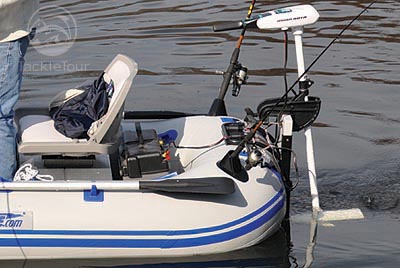
You can use an electric motor or gas motor up to 3 HP, or you can use the provided oars to row yourself around
 
New Sea Eagle 285 FPB: Now we take a look at the new Sea Eagle(SE) 285 FPB (Frameless Pontoon Boat). The SE 285 is a U-shaped inflatable that almost looks like an oversized float tube, it is designed to be powered with either a gas or electric motor, or good old fashioned oars. When it comes to ease of setup Sea Eagle claims it takes only 5 minutes to inflate and rig this boat.
 
The optional motor mount
 
Here are the detailed specifications of the Sea Eagle 285 FPB:
 
Sea Eagle 285 FPB Specifications and Included Items
Size 9 ft long x 4 ft wide
Weight 42 lbs (hull weight)
Air Chambers 2 separate air compartments
Persons 1 adult or up to 450 lbs
Material 1000 denier polyester PVC
Rod Holders 2 built-in
Footrest Aluminum step bench/footrest
Flooring Full fabric
Carry Handles 4
Motor Electric or gas up to 3HP
Stow Bag 1 clip-on pouch
Seat Inflatable
Oars 2 aluminum oars
Pump Foot pump
Storage Nylon carry bag
MSRP $499.00
 
Included is a clip-on stow pouch
 
The SE 285 FPB is designed to be rugged, lightweight, and ultra portable weighing in at only 42 pounds and when deflated, can be packed into a small bag and transported in any vehicle. Transportation is made easier because the entire boat is frameless. With the SE 285 FPB's design no metal frames are needed for stability.
 
Optional Equipment
Motor mount for electric or gas motor up to 3 HP
Swivel Seat
Floor board
 
Two rod holders are built right into the back of the inflatable
 

Conclusion: Inflatable boats offer a blend of performance, portability, and value for anglers, especially those who enjoy hitting remote lakes or don't want to deal with maintenance that accompanies a traditional boat. Even though I personally run a Boston Whaler on most of my field tests, the Sea Eagle inflatable lineup has always been my choice when fishing smaller lakes where hand launching is possible. The Sea Eagle 285 FPB is the company's latest offering and does what Sea Eagle is best known for, building small, easy to carry, and quick to set up watercraft. Unlike many other inflatable boats it is specifically designed for fishermen, and with innovative features like two integrated rod holders this boat is sure to please anglers on the go. The Sea Eagle 285 FPB will be available at the end of May 2009 and can be bought directly from Sea Eagle's website. Stay tuned as we put this boat through the paces in an upcoming full fledged review. Eastern Sierras here I come. 


Monday, 26 May 2014

Which Style of Fishing Kayak Is Right for You?

Kayak fishing has become a major pastime. The surge in kayak fishing has been met by kayak manufacturers with more and more styles of kayaks designed exclusively for fishing. Generally these feature fishing accessories such as rod holders and are more stable to allow for movement without overturning as easily.
There are so many kayaks on the market- and specifically fishing kayaks- now that the choice at first can seem daunting. Kayaks come in a variety of lengths, shapes and materials- each designed for a specific purpose. It is best to select from those kayaks that are designed specifically for fishing. Even when you limit your search to fishing kayaks, there are hundreds of models to choose from. The sport however is dominated by a couple dozen models which repeatedly are the favorites among kayak fishermen. Often it is best to stick to a tried and true favorite. There are a number of considerations in selecting the kayak that is right for you and your intended use.
The first, most basic consideration in kayak selection is the type of kayak. There are essentially two types of kayaks- the sit in kayak and the sit on top kayak. There are other vessel options such as the inflatable kayak and pontoon boats and other small fishing craft.
A SIK is the traditional type of kayak that one thinks of when they envision a kayak. You sit in a cockpit inside the kayak. Any water that comes over the side must be physically removed by bailing or with a pump. Water can be prevented from entering the kayak with the use of a "skirt" which is a membrane that goes over the opening of the kayak that has an opening for your torso. It is a required accessory for white water kayaking and kayaking a rough ocean. One advantage of the sit in kayak is that it can keep you dryer - especially when fitted with the skirt. Often greater stability and maneuverability can be achieved with a sit in kayak as your knees grip the inner walls of the kayak which is what makes this model the favorite among those who kayak for the sake of kayaking. The sit in kayak can however be more difficult to get in or to bail if they overturn, and in one you will have more limited mobility. Among sit in kayaks, the Old Town Dirigo 120 Angler Recreational Fishing Kayak is a favorite for its stability and versatility.
The sit on top kayak is the more popular fishing kayak as they let you fish from a variety of positions and they have greater storage. SOTs are moulded tubes that you sit on rather than in. Any water that ends up on the kayak drains through holes that run from the top to below the water line. These holes are called scuppers and they eliminate the need to remove the water as the properties of the designs does this. This means however that you will get wet so dress appropriately as you are exposed to the elements. The sit on top allows you to get on and of with greater ease and is easier to regain if you overturn. The sit on top is a great choice if you will be standing, getting off or on, or if you want to be in contact with the water or sit side saddle while fishing. Models such as the Perception Sport Pescador 12 angler kayak are a favorite for their storage, maneuverability and style.
Inflatable kayaks are another option. They have some advantages on their own over both the sit in kayak and the sit on top kayak- namely that they can be deflated and easily stored and carried. This might be necessary if storage is limited or if you would like to hike in to a remote fishing spot. These are essentially a bit of a hybrid between the sit on top and the sit in kayak as they are often open to the elements but have side panels that surround you. They have great stability but generally don't track quite as well as the SOT or the SIK. These can have the tendency to collect water and a bailing pump or one with a drainage system is best for this reason. Bic Yakkair Fishing 2Hp Inflatable Kayak is a favorite for its light weight, carrying pack and built in water run offs.
Pontoon boats are another option for a small fishing vessel. If you like to fish on generally calm waters and like to be in a seat which allows you rotation and maneuverability, then this can be an excellent choice. There is plenty of storage space and increased movement while fishing. These can be extremely stable and, while they are open and one is exposed to the elements, the elevation of the seat keeps you from coming in contact with the water. These also can be fitted with a motor so this kind of boat is a good option for those who do not desire to paddle. Pontoon boats can also allow for increased mobility and excellent storage as some models collapse easily. If you fly fish the ability to stand and sight fish makes makes this a good option. The Sea Eagle FoldCat Inflatable Boat is a favorite for its easy of assembly and its versatility.
You can find more at Which Style of Fishing Kayak is Right provided by Randy Stuart at Best Fishing Kayak Reviews.


Article Source: http://EzineArticles.com/?expert=Randy_Stuart

Sunday, 27 April 2014

Best Sit-On-Top Fishing Kayak

Fishing Kayak Reviews: Best Sit-On-Top Fishing Kayak

Best Sit-On-Top Fishing Kayak
Perception Sport Pescador 12 Angler Kayak
The Perception Sport Pescador 12 Angler is hands-down the favorite fishing kayak in its class. Made from the same mold by the same manufacturer as the 2008 Wilderness System's 120, the Pescador 12 Angler is undeniably considered a classic among quality SOT fishing kayaks. The Pescador 12 is touts all the benefits at half the price of its predecessor.
The Pescador 12 ships with everything you need to get immediately on the water- a rod holder in both the front and in the rear, drink holder, comfortable seat and water tight storage compartments. A comfortable soft seat allows hours of comfortable fishing and the maneuverability to sit sideways and rotate to access gear and fishing lines. The dry storage compartment and on board roominess allow plenty of room for enough gear for overnighters and camping trips.
Thanks to its tough and rigid frame work you need not worry when the wind blows a bit stronger as it is highly stable and buoyant handling 3' swells. Thanks to its multichannel hull and broad stable design, this fishing kayak tracks well and is much easier to maneuver than others in its niche. The Pescador 12 Angler is the only fishing kayak in this price range that has includes accommodations for an after-market rudder kit should a rudder be desired.
When looking for a fishing kayak offering stability and versatility then the Pescador is the right choice for you.
Features
• Comfort Seating System with adjustable height
• Tankwell with Bungee
• Center Day Hatch
• Bow and Stern Hatch
• Cup holder
• Paddle Parks
• Keepers foot brace system
• Scupper holes
• Flush-mounted rod holders
• Scotty Baitcaster Rod Holder
• 64 lb Anchor Kit
• Three year Warranty

Specifications
• 12-foot length x 28-inch width
• 18.5(W)-by-38-inch(D) cockpit
• 15-inch height
• 60-pound weight
• 350-pound weight capacity
• 1 person passenger capacity

Pros
• Less Expensive than other kayaks in its class
• Light enough to portage
• Very Stable
• Faster than other SOTs
• Tracks well even without a rudder

Cons
• Scupper holes can allow water in certain conditions
• Overall weight may at times be disadvantageous

Rating: 4.8:5
Sit On Top:
SOTs are the new breeds. They're essentially glorified surfboards. Rather then sitting in the kayak, as one does in a SIK, you sit on the kayak. The kayak is a hollow tube that has posts that run from the top of the kayak to the water. These posts are called scupper holes. They are what make a SOT kayak what it is because they allow water that enters the kayak to drain. There isn't any need for sponges or pumps as the kayak is self-bailing. SOTs were created as recreational kayaks that were originally used at warm water resorts as play vessels. They're popularity has been increasing each year and besides resort use they're also used for general recreation, kayak surfing and fishing. These have become very popular for fishing and offshore use. They can take a wave or a wake from a boat and self bail through the scuppers (drain holes)

You can find more at Best Sit-On-Top Kayak provided by Randy Stuart at Best Fishing Kayak Reviews.


Article Source: http://EzineArticles.com/?expert=Randy_Stuart

Wednesday, 23 April 2014

AdvancedFrame™ Inflatable Kayak

Author: Kathleen Pilney
Being that my kayaking experiences are based in hard-shelled kayaks, I was a little skeptical of the "kayak in a bag." But what the heck? A lot of catchy gimmicks get their start because of their novel quirkiness – like the famous Chia Pet and Soap On a Rope. I hoped this too would become a thriving product worthy of its place in pop culture, but I wasn't fully confident at first.

AdvancedFrame™ Inflatable Kayak
There's not a whole lot of water in the Sidney, Neb. area – and even fewer kayakers - so the best way to coax a paddling companion to tag along is by providing the equipment. This inflatable kayak would serve that purpose. I tied my Perception down on my car's rooftop, packed the deflated kayak in the back of my car and headed up north to the Black Hills in search of water. And because I suddenly had access to a second boat, I was able to entice a friend to join me.

AdvancedFrame™ Inflatable Kayak
The kayak-in-a-bag experiment started at Angostura State Recreation Area, a reservoir with 36 miles of shoreline outside of Hot Springs, S.D. It was like Christmas day as I stood near the lakefront and unpacked the much-anticipated gem from inside its duffel. I unfolded it, inserted the hand-pump adapter inside the chambers, and within a few minutes I was staring at a full-size kayak. In fact, it only took about five minutes to fill the seven total chambers. Chamber one and two fill the main chambers that run on either side of the boat's interior, similar to float bags. Chamber four and five inflate the coaming chamber, which is useful should you want to attach a spray skirt (sold separately).

A separate air mattress lays across the bottom of the boat for extra support. It also doubles as a sleeping pad should you find yourself in need of an extra. And the seat simply clips into place. The adjustable straps can be tightened to your liking for extra back support. The last and final two-second step is to place the plastic inserts labeled "bow" and "stern" into their respective places – and you're well on your way to a fun outing!

AdvancedFrame™ Inflatable Kayak
Blow up chambers – it's not a lot of hot air
The Advanced Elements™ Spring™ valve is compatible with most standard pumps. Just push in and twist to activate the spring-loaded opening, insert the foot or hand pump adapter and pump away. It's as easy to deflate by pressing in the same spring-loaded button and flattening it out until it's exhausted of air. Using a compression pump is not recommended since the boat fills so quickly, and it would be easy to overfill it.

And featuring…the nuts and bolts
The Advanced Elements inflatable uses a three-layers system that's difficult to puncture, so you'll feel confidant as you glide over shrubs and sticks in swampy water. Layer one, the hull (kayak bottom) is made of a super-thick 1mm 1,000-denier polyester wall with reinforced PVC tarpaulin. Layer two, the tube covering, is made of high-density PU coated polyester. And layer three, the main chamber, is made of heavy-duty 30-gauge PVC. Plus, the hull has double-material reinforcements at the bow and stern and welded-on landing plates for protection when beaching.

AdvancedFrame™ Inflatable Kayak
The AdvancedFrame™ holds an impressive 300-lbs. maximum weight capacity. I noticed a slight sagging where the hips align with the hull, but that may have been due to not inflating the kayak to full capacity. Besides, although visible from the outside, I couldn't feel the sagging from inside the boat.

There's plenty of on-board storage room for smaller items and dry bags behind the seat, inside the mesh pockets on the back of the seat and underneath the bungee deck lacing. The neoprene paddle guards along the coaming keep hands from getting scraped up along the sides while paddling. There aren't any foot pegs, but a tight cinching of the adjustable seat seems to give you the back leverage needed to paddle. Or you could opt to purchase a friction fit foot brace add-on from Advanced Elements.
Add-ons – those little special extras AdvancedFrame™ sells a number of useful features to complement their boat, like a spray skirt, which keeps the waves out and the warmth in. You can also upgrade the seat to one with an inflatable lumbar for even more back support. Remember to buy a bellows foot pump or a double-action hand pump to make inflating a breeze. And search cabelas.com for a PFD, a paddle, dry bags and a hydration system of some sort. Don't forget the sunscreen and hat. And waterproof gloves of some sort are advisable when paddling in cooler temperatures.


The solver of small setbacks I've done a lot of solo kayaking, which I prefer from time to time, but there are occasions when company would be appreciated. Owning only one kayak makes it difficult to entice family and friends to tag along. "Come on! It will be fun for you to watch from the shore as I paddle around the lake." Try this line and you're almost guaranteed an invitation's rejection. The AdvancedFrame™ is not only a price-friendly solution to this predicament, but a space saver to boot during transport. It also solves that problem of not having a rooftop carrier, and alleviates the hassle of transporting two kayaks.

The AdvancedFrame™ kayak also minimizes what I'd call the pack-rat guilt syndrome (PRGS); that nagging internal voice that demands you use every item you've packed for your vacation. With its inconspicuous size, no one ever has to know you've hauled it across four states just so it could sit in your car's trunk. And since it fits easily inside your car or truck, there's no added gas cost associated with the drag created from carrying a boat on your rooftop.

The kayak in a bag also minimizes the neck ache from keeping your head turned and eyes peeled on the kayak on your rooftop while you stand in a 45-minute grocery line waiting to buy that stick of butter. The odds of a rooftop kayak theft increase incrementally over long distances and with each stop. If the kayak isn't visibly lounging on your rooftop as a thief attractant, that worry is suddenly removed and space is freed in your mind for more enjoyable thoughts.

And lastly, purchasing this boat is a great way for the beginning paddler to test the water before diving in headfirst. And this boat so closely simulates the experience of paddling a hard-shelled kayak, you'll be encouraged to continue the sport instead of being thwarted.


A balancing act it isn't
My friend, a first-time kayaker, told me he felt much more comfortable and secure in this boat versus my topsy-turvy whitewater boat. Perhaps the hard-edged bow and stern contributed to its stellar tracking performance. And the built-in aluminum ribs certainly help, considering they give definition to the bow and stern. The skeg tracking fin also contributes to the kayak's grace out on the water.

So what are you waiting for? It's high time you replace the excuses that hold you back from experiencing kayaking with this more tangible and fun AdvancedFrame™ Inflatable Kayak. Buy it today. You won't regret your actions.

View our collection of Advanced Elements Inflatable Kayaks.
Dimensions: 10'5"L x 34"W.
Weight: 36 lbs.
Maximum weight capacity: 300 lbs.

The Advanced Elements AdvancedFrame™ Inflatable Kayak will be available in retail stores and online starting on January 01, 2009. Search cabelas.com using keyword "inflatable kayak" or item number: 02-0371. 


Source

Monday, 21 April 2014

Predator Fishing Kayak

by: theangler

Old Town, Maine Old Town Canoes & Kayaks, one of the most storied brands in the paddlesports industry, today launched the new Predator kayak. Developed in combination with Old Town's renowned designers and pro staff members throughout the country, the Predator is completely engineered, below and above the waterline, to deliver the perfect platform for fishing.
The Predator brings anglers closer to the water and the action with nearly unlimited options to customize the kayak around their specific equipment and unique needs. Featuring six strategically-placed, removable mounting plates, the Predator enables consumers to install rod holders, GPS units, fish finders, cameras and more virtually anywhere around the boat without drilling into the hull so they can tailor the craft for their personal style.

The Predator boasts standout features including the
three-stage Element™ seating system that can be
lowered for paddling, raised for fishing or even flipped
out of the way in stand-up mode for poling, sighting
and casting. The proprietary, slip resistant Exo-Ridge™
deck is designed for sure footing and superior drainage,
while the Tri-hull construction provides both incredible
durability and stability. A package unique in the marketplace,
the Old Town Predator ensures anglers can paddle in comfort,
arrange equipment to their exact specifications and even stand to fish.

"In designing and building the Predator, we set out to turn convention upside down and deliver a totally new fishing experience," said David Hadden, Old Town Brand Director. "The Predator still delivers the stability and comfort kayak anglers demand, but the ability to customize this kayak to your specific needs, and adjust it on the fly as your needs change, helps set it miles ahead of the competition."
The Predator possesses a large capacity center console for maximum storage and additional mounting options, while dual rod tip holders at the bow help store valuable fishing rods safely and securely. Other key features include a large bow hatch with Old Town's patented Click Seal cover, scupper holes for quick drainage, large rear tank well with Exo-Ridge design to keep gear accessible and dry, paddle keepers, adjustable foot braces and side-mounted rod retainers that allow for convenient grab and cast.

The Predator is tailor made to accept aftermarket options like Scotty™ outriggers, Steady Stand-Up Bar and a Minn Kota™ trolling motor mount. Available in two new models, Old Town Predator kayaks land at authorized dealers in Summer 2013. Key specs include:

Predator 13 Predator MX

Length: 13' 2" Length: 12"
Width: 33.5" Width: 34"
Seat Height: 15" Seat Height: 15"
Leg Length: 48" Leg Length: 48"
Weight: 72 lbs. Weight: 68 lbs.
Max Capacity: 400-425 lbs. Max Capacity: 375-400 lbs.
MSRP: $1,299 US MSRP: $ $1,199 US

Get closer to the action, visit: www.predatorkayak.com

Old Town® is part of the Johnson Outdoors family of innovative, market-leading brands. The company designs, manufactures and markets a portfolio of top-quality products for the global marketplace across four categories: Watercraft, Marine Electronics, Diving and Outdoor Equipment. Johnson Outdoors' familiar brands include, among others: Ocean Kayak™, Necky® kayaks, Old Town® canoes and kayaks, Extrasport®, Carlisle® Paddle Gear, Minn Kota® motors, Cannon® downriggers, Humminbird® fish finders, SCUBAPRO® dive equipment, and Eureka!® tents. Visit Johnson Outdoors online at www.johnsonoutdoors.com. 
Source 

More Fishing News: www.gofishtalk.com

Saturday, 19 April 2014

Kayak Fishing – A Growing Fishing Sport

Pick Up Your Boat and Head Out Kayak Fishing


Kayak Fishing © Ron Brooks
Paddlers hit the marsh for Kayak Fishing
Kayak Fishing © Ron Brooks
Kayak fishing is growing at an amazing rate. This relatively new fishing sport is becoming more and more popular every day. Areas where I used to fish and have the water all to myself are now being regularly sought by kayak fishermen. In the past, kayak fishing was pretty much looked at as a curious anomaly in saltwater. But, today, kayaks are being made specifically for fishing, with bells and whistles that meet an angler’s needs. Kayak fishing has arrived!

What You Need

Obviously the first thing you will need is a kayak. Not many places have grown to the point of renting fishing kayaks, but many areas offer the best made fishing kayaks at a price much less than a full sized boat. You can get an idea of what types of boats are available at About.com’s Paddling site.

Fishing Equipment

The fishing gear required for kayak fishing is not any different than any other fishing gear. It needs to be tailored to the fish you plan to pursue. Spinning gear, because of the relative ease of handling, and the longer rod butt works well in a kayak. That longer rod butt makes it easier to stay put in a rod holder.

Where to Launch

I suggest planning your trip by picking an area where larger boats will not interfere with your travels. Not all boaters are courteous enough to slow to a “no wake” speed when they pass paddlers. Launching can take place anywhere you can gain legal access to the water – which means stay off of private property, and make sure it is legal and safe to leave your vehicle parked where you launch. Kayak fishing makes so many places launchable, and some of them could very well include private property or road right-of-way. The beauty of kayak fishing is that you can literally go “where no boat has gone before” – power boat that is. You can access shallow water, water that won’t float even a kayak at low tide. This past week I encountered kayak anglers fishing at high tide in an area that is a huge, dry mud flat at low tide. They told me they could fish it for about two hours before heading off the flat. I had trouble leaving the flat with my boat and trolling motor, and the tide had only been going out for about a half hour.
Many kayak fishermen use a super kayak and actually fish the ocean. Although, I’m not sure how far they can stand to paddle to fish, many anglers have caught king mackerel, and even sailfish from their tiny boats. Obviously it takes an adventurous soul and a day of lighter winds to fish the ocean.

Where to Fish

This is where the kayaks have an extreme advantage. They can fish areas that are untouched by other anglers. Back country mud flats, oyster rakes, and salt marshes are all accessible and fishable in a kayak. Take a chart of your area – a NOAA chart – and find some of those back areas, and look for an easy launch or access point. Go there at low tide and scout the area from land if possible. Look for holes, drops, oyster bars, etc – anything that can attract fish. Then mark your chart, come back about two hours before high tide, and launch. You should be able to fish all the way up to high tide and an hour or two after the tide turns. There are creeks and runs that hold plenty of water at low tide to float a kayak, but not enough to float a bigger boat. These are ideal locations. The trick is to get off the beaten path and look for areas that other anglers can’t reach.

What Do We Catch?

The species of fish that populate an area differs from south to north and from east to west. In the southern Atlantic states up to New Jersey and New York, expect to find red drum, spotted seatrout, flounder, jack crevalle, ladyfish, bluefish and more. In other areas, look for the fish that migrate to the shallow salt marshes looking for food.

Cautions


  • You must remember that you are paddling in areas that may not float a boat at certain tide stages – like low tide!
  • Plan your trip accordingly and make sure you leave yourself enough time to paddle back to the launch site before the water runs out.
  • Take plenty of water – being stranded for several hours is not a fun thing in the hot sun.
  • Paddle in pairs. It is not advisable to fish from a kayak alone. Always plan to take a partner along in another boat.

Tournaments

Kayak fishing tournaments are popping up all over the place, and more are being planned every day. This popular sport is available to many anglers who can’t afford any other way to get on the water, and tournaments are a natural outflow. Look for tournaments in just about every state on both coasts. They are springing up everywhere. And, for more information on kayak fishing, visit our About.com Kayak Fishing Resource pages.


Source 

More Fishing News: www.gofishtalk.com

Tuesday, 8 April 2014

Skill Builder: Kayak Fishing Kickstart

Quietly stalk the best spots from the comfort of a kayak.

By Keira Quam
I started kayak fishing several years ago. I had a kayak and a fly rod, but hadn’t put the two together. My first time out was a great experience, so I was hooked.
Kayaks quietly maneuver to the best spots, even in shallow water. They provide access to areas where it’s difficult to stand or walk for wade fishing. No matter where you are, they allow you to get up close and feel a part of your surroundings.
Kayaks come as sit-in or sit-on-top varieties, from simple ones to ones designed for anglers. You can start out with one you have, or rent or borrow to try out different styles. A sit-in kayak with wide cockpit works best for me. I like to tuck all my things inside the boat for easy access. Other anglers like the convenience of a sit-on-top to straddle the hull, get on and off quickly and not worry about water in the boat. Some sit-on-tops even have foot pedals for propulsion, leaving your hands free for fishing.
Kayak fishing

Kayaks provide a convenient way to get to spots that otherwise might be difficult to access, whether fishing in fresh water or salt water.

Be sure to pack light, but here are some essentials for your trip:
• A fishing license, rod and reel, a net and tackle. Conventional rods or fly rods work fine. I use both. (Remember, no license is needed if you are fishing inside the boundaries of a state park, or are under age 17.)
• A life jacket. Look for the newer designs that allow for lots of shoulder movement.
• A TPWD Outdoor Annual (view it online at www.outdoorannual.com) so you know if it’s legal to keep the fish you catch.
• A paddle leash or some way to let go of your paddle and not have it float away. Forget this one time and you’ll know what a difference it makes.
• A bicycle flag for the back of the kayak so you can be seen by others in the daylight, and a white light for the boat if you are traveling near sunset.
• An anchor. If the wind is blowing or the current keeps carrying you downstream, it is nice to have a way to stop at that great fishing hole you found. Some people also use a pole to jab in the bottom and hold the boat securely in place.
• Clothing made of synthetic fabric that dries quickly. Remember a hat and sunglasses, too.
• Enough food and water in case you are out longer than expected.
• A small first-aid kit, flashlight, whistle and cellphone in case you need to call for help or will be home late. Waterproof cases work for cellphones and car keys.
• Carabiners and bungee cords. Tie or hook stuff to your boat in case you catch a big fish and it pulls you off-balance.
■■■
In addition to wearing your life jacket, always prepare to be safe.
• Make sure someone knows where you are going and when you are expected back.
• Know how to exit and board your kayak.
• Learn the paddling strokes that don’t tire your arms and that allow you to turn or stop quickly or pull up sideways.
• Like roads, travel on the right side.
• Bring a friend. It’s safer, and you’ll appreciate the help. Recently my fishing buddy asked me to remove the fish hook from the rope in the front of his kayak. Shortly after that, I needed the same help.
Whether you venture out on a lake, on a river or at the coast, kayak fishing is fun and rewarding. There are wonderful resources on the Web, including how-to instructions, tips on where to fish, forums, magazines and clubs. 

Source

Saturday, 8 March 2014

7 Steps for Organizing Soft Plastics


by: Walker Smith

image

Organizing your bass fishing soft plastics doesn’t have to be confusing, daunting or frustrating. Although it may seem like a bunch of mind numbing labor, I’ve been using a simple organization system that allows for much easier and more modular storage.
This system has given me 5 major advantages since implementing it.
  • Find what you need in a hurry—Fishing is a time-sensitive sport. When a group of bass gets fired up, you need to be able to re-rig and continue casting within a few seconds. Your preparedness often correlates directly to your success.
  • Lighten your load—There’s no sense in carrying hundreds of extra pounds in soft plastic baits when you’re bass fishing. It slows down your boat, hurts your fuel mileage and negatively impacts your ride in rough water. If you have the bass dialed in, grab the baits you know they’re eating and get out there.
  • Portability—If you fish team tournaments with a partner and alternate boat use between tournaments or lakes, you don’t have to dig through all of your compartments when transferring your gear into another boat. Simply grab what you think you might need and get it done in less than five minutes.
  • Easy inventory—We all do it. Every bass angler buys multiple packs of the same baits that they don’t really need. Over time, you’ll probably find ten full packs of identical baits and colors. That wastes money and space and this system helps you keep an eye on your spending habits.
  • Affordable—I organized all of my soft plastics for under $10. No expensive, bulky, space-wasting plastic totes. Just one inexpensive trip to the grocery store will take care of it.
Step 1: Dump it
It’s probably going to drive you crazy—even though your soft plastics are in major disorder, you always knew where your favorite color “might” be located. Try to get over it because something better is on the horizon.
Go through your boat or tackle storage area and put every bag of soft plastics you own into a big trash bag. Lug the trash bag to your work area—about eight or ten square feet will do—and dump it like a bad date. If you’re a tackle junkie like we are, you’ll probably be shocked by the amount of baits you own that have never been used. This process will help put things into perspective for you.
Step 2: Categorize broadly
soft plastics for bass fishing
Like all of these categorizations, yours will probably differ from mine. We fish different lakes, travel different places and favor different fishing styles. As long as you begin with the broadest categories you can think of, you’ll be just fine.
I organized mine in a very simple manner. After dumping it all onto the floor, I separated it as follows.
  • Paddle tail swimbaits—Because I fish a lot of dirty water, I don’t use swimbaits very often. As a result, I don’t keep very many in my collection. The packages were fairly large and easy to cherry pick from the pile, so I pushed ‘em off to the side.
  • Toads and topwater soft baits—Again, this type of fishing isn’t very conducive to my style and home fisheries, so I shoved these baits to the side in their own little pile—primarily to get them away from the “meat” of my project.
  • Soft jerkbaits—These were already semi-organized—by that I mean piled in a few ripped Kroger bags—so I set them to the side. You probably have a similar situation with different types of baits, so try it out.
  • Worms—It didn’t matter what kind of worm it was for me. If it looked like a worm, I put it in a pile, throwing color, style and application to the wayside for the time being.
  • Creatures—For the sake of simplicity, I considered everything I would flip, pitch, use as a trailer or drag behind a Carolina rig a “creature”. If it had appendages or didn’t look like a worm, this is the pile I put it in.
Step 3: Separate it further
I could tell you this part is fun, but I’d be lying. I’m not a tinkerer, so my attention span with tedious categorization tasks is limited at best. With the help of a few cold beers and Pandora radio, however, I got it done in about an hour. Once you get past this part, the following steps will be much easier.
Before you go into robot-mode and start throwing little plastic baggies everywhere, it’s important to consider both your fishing style and how your mind works on the water. What are some of your favorite techniques? What do you consider a “craw”? How does that differ from a creature bait? There’s no right or wrong answer—whatever works best for you.
I’m a visual thinker, so I pulled up a Word document on my computer and made a bullet list to help me get my proverbial ducks in a row. Again, keep in mind—everyone’s list will be different. I suggest using my list as a simple guideline to your own organization system. Feel free to place your favorite, most heavily used baits into their own category for added convenience. You’ll notice a few instances in which I did it.
  • Flipping and pitching
  • Toads and topwater
  • Cut tail and speed-type worms
  • Curly tail and big worms
  • Soft jerkbaits
  • Paddle tail swimbaits
  • Stick worms
  • Finesse and shaky head
  • Trick/floating worms
  • Lizards
  • Craws, chunks and trailers
  • Zoom hogs (Brush Hogs, Baby Brush Hogs, Super Hogs and Z Hogs)
Step 4: Subcategorize by color
label your bass fishing soft plastics
If you know your favorite lake is the color of chocolate milk, there’s no need to pack your more natural-colored baits. This is why I chose to subcategorize each major category by color. It allows me to pack lighter, have more room in my boat and I don’t have to dig through a bunch of irrelevant colors to find what I’m looking for. It also makes it much easier to pond hop on the weekends if the bass in your favorite honey holes fancy particular colors.
I decided to keep it simple by making two subcategories. I don’t get too carried away with color selection with my soft plastics, so it was an easy decision to make.
  • Light-colored—I put anything green or natural-colored into this category.
  • Dark-colored—Anything I use in dirty water, primarily blues, blacks and purples were considered “dark”.
Step 5: Consolidate and wipe down
consolidate your bass fishing soft plastics
This step will save you a ton of space. I had several packs full of one or two specific color and style of baits, so I combined them all into one bag. Instead of a pack holding 10 baits and a bunch of air, I filled ‘em to the brim. After about 20 minutes of consolidating my baits, I was left with an enormous pile of empty plastic baggies and a better understanding of what colors I don’t need any more of.
It’s also a good idea to take this opportunity to wipe down your soft plastic packages. Over time, they’ve probably been “slimed” by bass or greased-up by a leaky can of crawfish spray, so keep a wad of paper towels nearby. This will keep your baits from swelling and, in some cases, rotting and becoming useless.
Step 6: Bag each subcategory and label
storage supplies for bass fishing soft plastics organization
Remember when you separated each category by color? Now is the time to bag them and make ‘em look pretty. This is the easy part when everything comes together.
I decided to use one-gallon Hefty storage bags when bagging by color. These bags are tough as nails and protect your baits well. If I had more than would fit into one of these bags, I put them in a separate storage area. I don’t need that many baits at one time, so I figured it would be best to get them out of the way until I need to restock.
After bagging, make sure you label each storage bag with a permanent marker to avoid any confusion or duplication of effort. For example, I’d label a bag “dark soft jerkbaits”.
Step 7: Combine into larger bags and label
subcategorized soft plastics for bass fishing
This is the final step and the easiest part of the whole production. For my larger bags, I used 2 1/2-gallon Hefty Bags because I can fit about three of the smaller bags into them.
Label your big bag with the categories you developed in Step 3 and put your subcategorized bags inside of them. I suggest labeling a big piece of duct tape on these bigger bags for easy identification while on the water. Step back and check it out—you’re now a more organized, efficient and mobile angler. Feels pretty good, doesn’t it?
Spring will be here before we know it and this is the best time of the year to get organized, take inventory and prepare yourself for the hustle and bustle of fishing season. This storage system has worked for me and I believe it will help you fish more efficiently and reduce your frustration.
organized bass fishing soft plastics